The journey from radioactive to stable
The journey from radioactive to stable
When spent nuclear fuel is removed from the reactor, a rapid process begins in which the radioactivity declines sharply, but the process slows down increasingly with the passage of time. This means that we have to keep the fuel isolated from people and the environment for a very long time.
Radioactivity decreases over time through radioactive decomposition, which transforms radioactive atomic nuclei into stable ones. Sometimes decomposition takes place in several stages before a stable nucleus is formed. Spent nuclear fuel contains several different radioactive substances, which contribute differently to activity during different periods of time. After 1,000 years, almost all direct radiation has dissipated, but we still need to protect people and animals from the indirect radiation that occurs if radioactive substances enter the body, for example by eating or inhaling them.
After 100,000 years, activity has fallen to a level equivalent to the amount of uranium ore originally mined to produce the fuel. At this point, radioactivity has decreased to a few thousandths of a percent compared with when the fuel was first received for interim storage at Clab.
Rapid decline in radioactivity before final disposal
In the beginning, the process moves quickly. Just one week after a reactor has been shut down, the residual radiation has decreased by 90%. At this point, the used fuel elements are removed from the reactor and placed in a fuel pool inside the reactor building. There, they remain for at least one year. During this time, the fuel’s radioactivity and heat generation drop by another 90%—or even more if the spent fuel stays longer in the pool. To reduce the radiation by another 90% from that level, the fuel must be stored for 40 years. During this period, it is kept in interim storage at Clab, the Central Interim Storage Facility for Spent Nuclear Fuel. After that, the fuel is ready for final disposal in the planned Spent Fuel Repository. This step is needed as the fuel is still highly radioactive despite the significant decline..
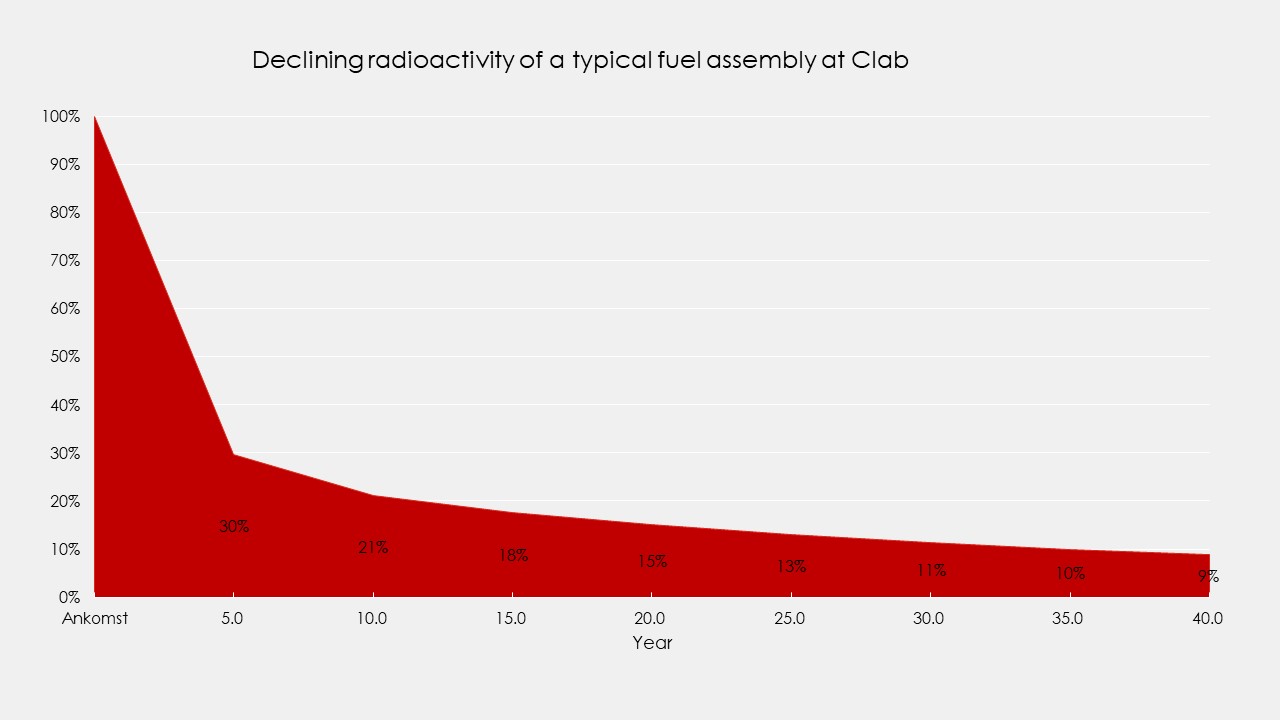
Decreasing activity at Clab.
Slower and slower decline in the final repository
After 1,000 years, activity is dominated by substances that are dangerous to ingest. Radioactivity has then fallen by a further 99% compared with when the fuel arrived at the Spent Fuel Repository.
For radioactivity to decay by a further 90%, we will have to wait until about 30,000 years have passed. Activity is then at a few millionths of the level when the fuel was removed from the core.
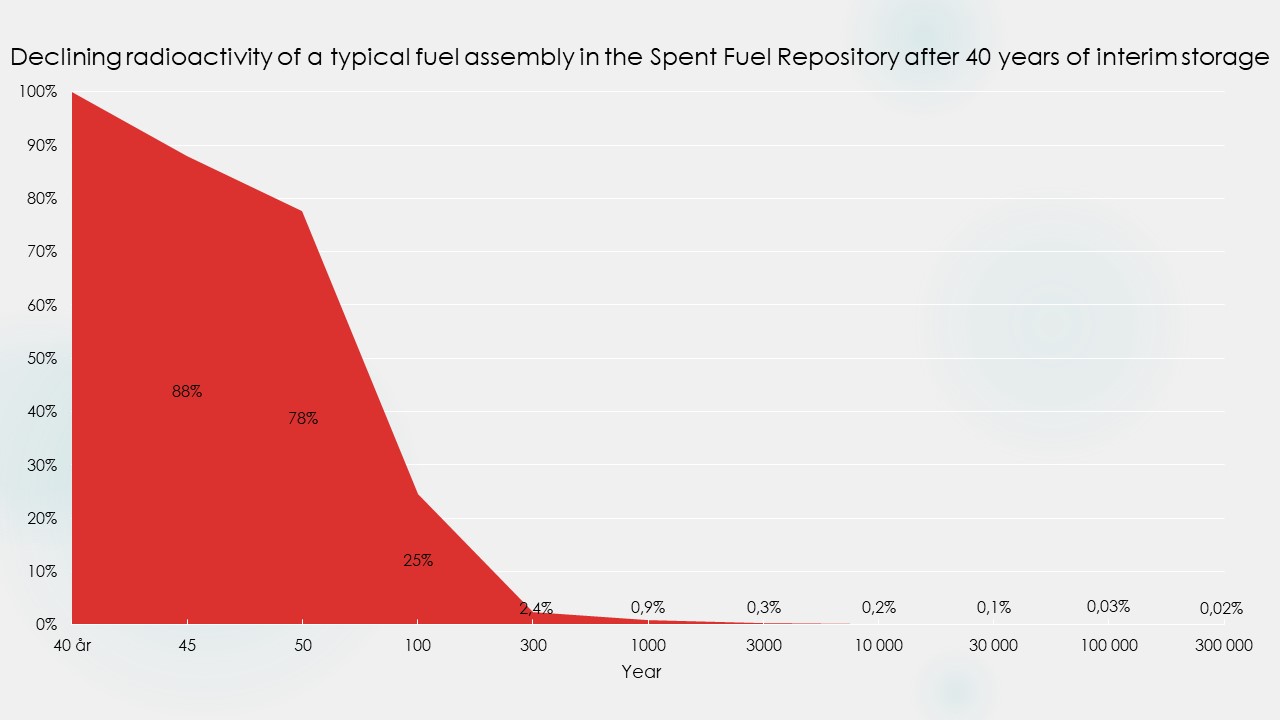
The chart shows how radioactivity declines in the Spent Fuel Repository.
Comparison of the decomposition rate over two different time periods
A 90% decline in radioactivity means different things, depending on when the decline takes place. If you compare how quickly radioactivity declines immediately after the fuel has been removed from the reactor with how it declines after 1,000 years, the initial decline is no less than 10,000 times faster. The first decline takes place in just one week, while after 1,000 years it takes almost 30,000 years for a similar decline to take place. Take a look at the table below for an overview of how the decomposition rate and radioactivity in the spent nuclear fuel decrease.
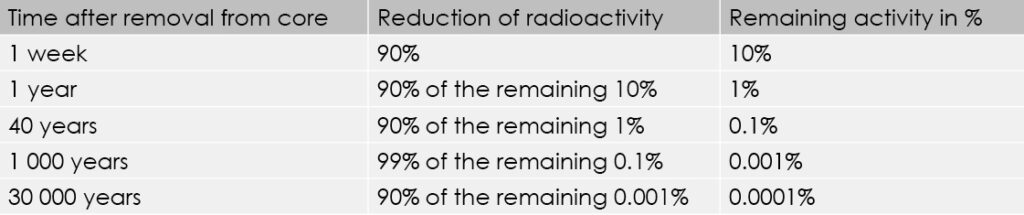
The lower the level of activity, the longer a 90% decline in radioactivity will take.
Importance of half-life for decomposition rate
Why does the curve look like this for the spent nuclear fuel? This is due to what is known as the half-life, i.e. the time it takes for half of a radioactive substance’s atomic nuclei to decompose. After a half-life, half of the original number of atoms remain, after another half-life, a quarter remain, and so on.
When radioactive atoms decompose and form new, stable substances, fewer radioactive atoms remain. Activity therefore decreases. The figure illustrates a substance with a half-life of 30 years.
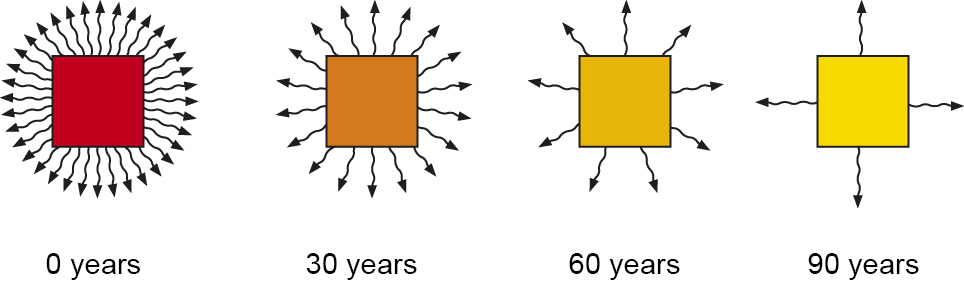
When radioactive atoms decompose and form new, stable substances, fewer radioactive atoms remain. Activity therefore decreases. The figure illustrates a substance with a half-life of 30 years.
Last review: January 27, 2026
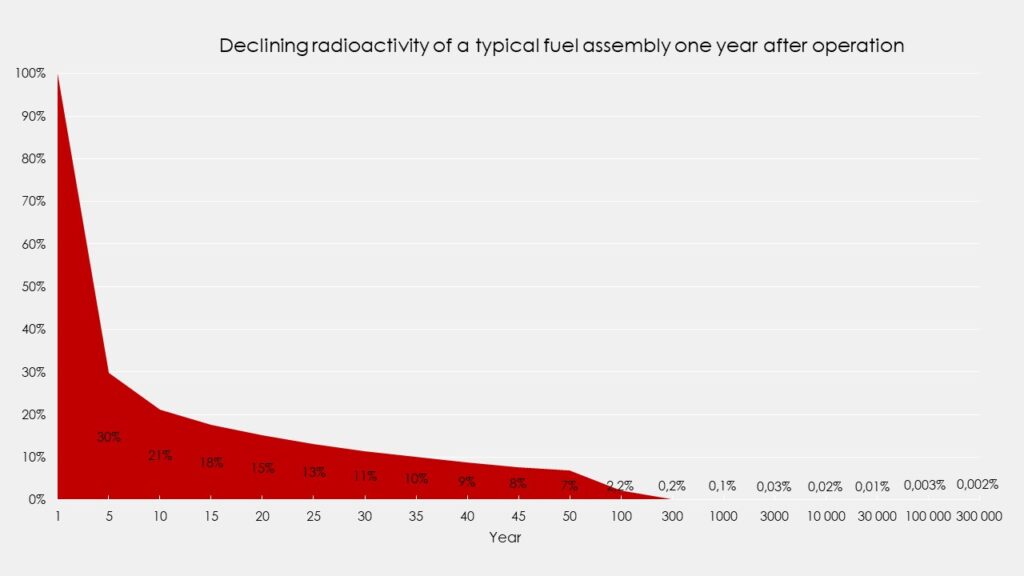 The curve illustrates how activity decreases from year 1 and for the next 300,000 years in the spent nuclear fuel.
Last review: January 27, 2026